Scope
(For the latest Information visit the Government HSE web site https://www.hse.gov.uk/)
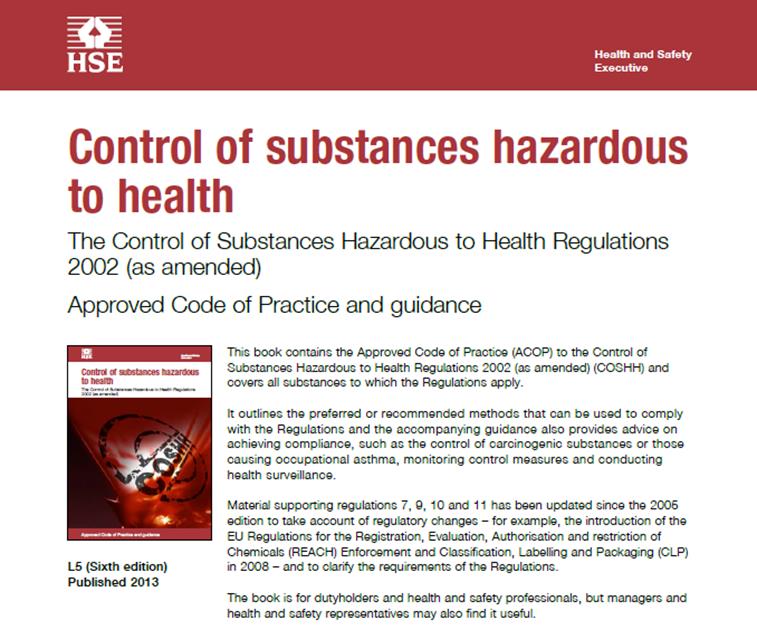
The Control of Substances Hazardous to Health Regulations, 2002, referred to as the COSHH Regulations, define “substance hazardous to health” means, a substance (including a preparation):
a) which is listed in Table 3.2 of part 3 of Annex VI of the CLP Regulation and for which an indication of danger specified for the substance is very toxic, toxic, harmful, corrosive or irritant;
b) for which the Health and Safety Executive(a) has approved a workplace exposure limit;
c) which is a biological agent;
d) which is dust of any kind, except dust which is a substance within paragraph (a) or (b)
above, when present at a concentration in air equal to or greater than –
a. 10 mg/m3, as a time-weighted average over an 8-hour period, of inhalable dust;
or
b. 4 mg/m3, as a time-weighted average over an 8-hour period, of respirable dust;
e) which, not being a substance falling within sub-paragraphs (a) to (d), because of its chemical or toxicological properties and the way it is used or is present at the workplace creates a risk to health;
If the packaging has any of the hazard symbols (See Below) then it is classed as a hazardous substance. COSHH also covers asphyxiating gases as well as germs that cause diseases such as leptospirosis or legionnaires disease and germs used in laboratories.
COSHH however, does not cover lead, asbestos or radioactive substances because these have their own specific regulations.